Autonomous AI agents: the next wave after ChatGPT that SMEs need to know about in 2026
Published on 2026-02-27 · 7 min read
After ChatGPT, here come autonomous AI agents that can act on their own. Concrete use cases, how they differ from classic automation, the risks, and a method to start safely.

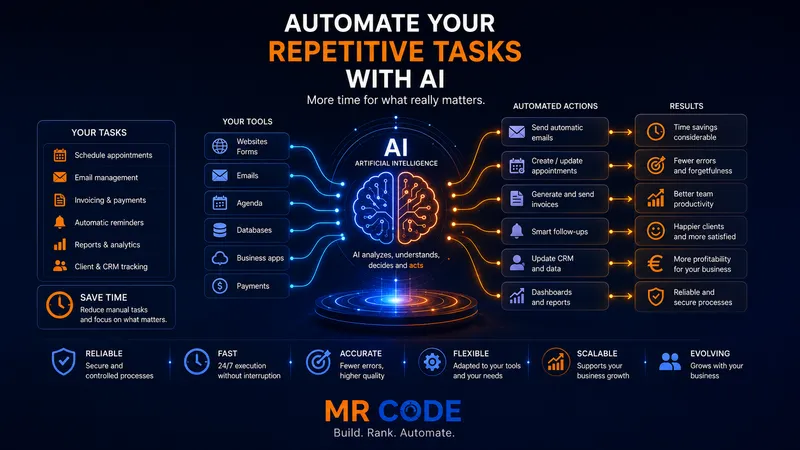
Since ChatGPT arrived, generative AI has mostly been used to answer questions and produce text. In 2026, the trend taking off in searches and inside companies is a different one: autonomous AI agents, able not only to answer but to act — chaining tasks together, using several tools, and making decisions without a human stepping in at every stage.
For SMEs this is a major shift, and a concrete opportunity to save serious time on processes that until now still needed constant human supervision.
Classic automation vs an autonomous AI agent: what is the difference?
It is important not to confuse the two, because they represent two different levels of maturity:
| Classic automation | Autonomous AI agent | |
|---|---|---|
| How it works | Follows a fixed rule: "if X happens, do Y" | Analyses the situation and decides on the best action to take |
| Example | Automatically send an invoice every month | Read a customer email, understand the request, and decide on its own whether to create a quote, reply directly, or hand it to a human |
| Flexibility | Low: only handles the cases planned in advance | High: adapts to situations nobody anticipated |
| Supervision needed | Occasional | Necessary at first, then gradually reduced as trust builds |
In short: automation runs a script, whereas an AI agent reasons and orchestrates several actions on its own.
Why this topic is exploding in search right now
Several factors explain the growing interest in autonomous AI agents in 2026:
- Large language models can now use external tools (calendar, CRM, email, databases) reliably.
- Businesses are looking for concrete productivity gains after several years of experimenting with classic chatbots.
- The cost of access to these technologies has fallen sharply, putting them within reach of SMEs rather than large groups only.
Concrete use cases for an SME
- Customer service: an agent that reads incoming emails, understands the request, checks the customer history, and writes a personalised reply — or hands it straight to a human when the subject is sensitive.
- Sales management: an agent that automatically qualifies incoming leads, updates the CRM, and books a meeting in the relevant salesperson's calendar.
- Administrative follow-up: an agent that watches invoicing deadlines, chases late payments with an appropriate tone, and raises an alert only when something looks unusual.
- Monitoring and reporting: an agent that tracks industry news or customer reviews and produces an actionable weekly summary. The principle is close to our AI Social Growth approach.
The risks and limits to know before starting
Adopting autonomous AI agents is not without precautions:
- Do not delegate sensitive decisions (legal, financially critical) without human supervision.
- Plan clear guardrails: in which cases the agent must stop and hand over to a human.
- Test gradually: start with a single process before generalising.
- Watch quality over time: an agent that works well at launch can drift as data or business context changes.
How an SME can start without getting it wrong
- 1. Identify a repetitive, well-defined process (not the most complex one in the company, to begin with).
- 2. Scope the agent's limits precisely: what it can decide alone, and what must always be approved.
- 3. Test on a narrow scope before a wider rollout.
- 4. Measure the results (time saved, errors avoided, customer satisfaction) before extending to other processes.
Common mistakes to avoid
- Trying to automate a process that is not yet clear internally: an agent cannot bring order to existing chaos.
- Granting too much autonomy from day one, with no gradual testing phase.
- Choosing this technology because it is fashionable, without having identified a real, measurable saving in time or money.
- Overlooking training for the teams who will supervise and adjust these agents day to day.
Conclusion
Autonomous AI agents are the logical next step after the ChatGPT wave: we move from an AI that answers to an AI that acts. For SMEs, it is a real opportunity to save time on repetitive tasks — provided you proceed with method rather than by following a trend. It is an approach we connect to our expertise in AI automation and custom development.
Want to identify the first process in your business to automate with an AI agent? Get in touch with MR CODE for an initial scoping conversation.