From idea to product: how to turn a concept into a real website or application
Published on 2026-02-11 · 7 min read
Between an idea and a real digital product, there is a method. MVP, technical choices, a realistic budget and the mistakes to avoid: here is how to go from idea to product without taking a wrong turn.

You have an idea. A service to digitalise, an application that would make your customers' lives simpler, a platform that could replace your spreadsheets and endless email threads. But between the idea and a real, working product used by real people, there is a gap that many founders never manage to cross.
At MR CODE, in Lyon, this is exactly what we work on every day: turning a concept into a concrete digital product, with no unnecessary detours and no empty promises.
Why most ideas never become a product
Three blockers come up almost every time:
- The perfect-product syndrome: wanting to build everything before releasing anything, instead of shipping a first testable version.
- The wrong technical choice from the start: picking a stack that is far too heavy (or a no-code tool that is far too limited) without having assessed the real needs.
- No validation: spending six months building a product nobody asked for, because demand was never checked up front.
The good news: all three are solved with a simple method, not with a bigger budget.
The 5 steps from idea to product
1. Clarify the problem, not the solution
Before talking about a website or an application, there is one question to answer: exactly which problem does this product solve, and for whom? A vague idea (« an app for tradespeople ») cannot be built; a precise problem (« tradespeople waste time writing quotes by hand ») can.
2. Define a realistic MVP (Minimum Viable Product)
An MVP is not an « ugly » version of the final product: it is the smallest version that lets you test the main assumption with real users. A well-thought-out MVP might be a simple site with a form, a basic dashboard, or a single key feature built properly — not ten features done badly.
3. Choose the right technical approach
Between custom development and no-code, the right choice depends on your horizon:
| Approach | Ideal for | Limitations |
|---|---|---|
| No-code (Webflow, Bubble, Glide) | Validating an idea quickly, on a small budget | Hard to evolve, dependent on the platform |
| Custom development (Next.js, etc.) | A product meant to grow, with specific needs | Higher initial cost and lead time |
| Hybrid (static site + AI automation) | SMEs wanting a fast site plus automated business logic | Needs careful scoping from the start |
The right choice depends on your horizon: a three-month test does not have the same needs as a product meant to scale over three years.
4. Build, test, adjust
Once the MVP is live, the real work begins: watching how people actually use it, fixing what gets in their way, and not adding a single feature that real usage has not asked for.
5. Industrialise what works
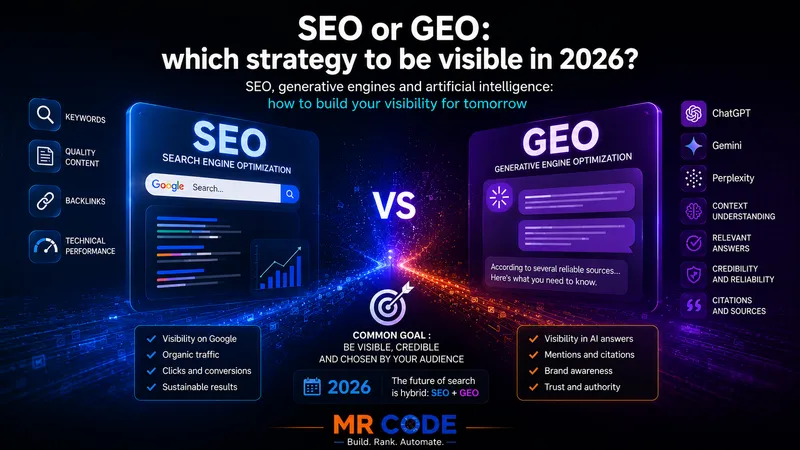
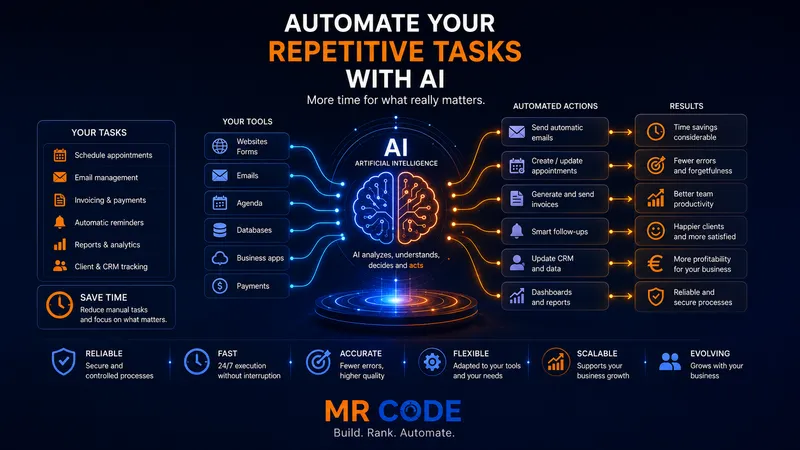
Once the product is validated, it is time to solidify the technical architecture, to automate the repetitive tasks (invoicing, notifications, reporting), and to prepare SEO/GEO for lasting visibility — rather than rebuilding everything in a panic six months later.
Budget and timelines: what to realistically expect
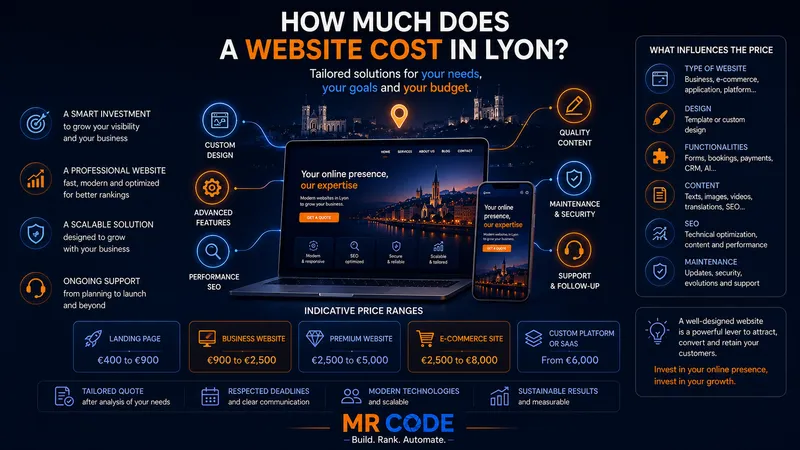
For a simple MVP (a site plus one business feature), expect roughly 3 to 8 weeks of development depending on complexity, and a budget that varies a great deal depending on whether you are building a site with a smart form or a genuine application with user accounts and a database. Be wary of quotes that look too good: a product that costs very little is often a product that has to be rebuilt a year later.
Common mistakes to avoid
- Trying to launch on every platform at once (web + mobile + API) in v1.
- Confusing « having an idea » with « having a market-validated need ».
- Choosing a provider on price alone, without checking they can evolve the product afterwards.
- Ignoring search visibility during design, thinking « we will deal with that later ».
Conclusion
Going from idea to product is not a question of genius or of a big budget: it is a question of method. Clarify the problem, build a first testable version, learn from real usage, then industrialise what works. That is exactly the approach MR CODE applies to every project, from the first conversation through to launch.
Have an idea you would like to turn into a real product? Get in touch with MR CODE for a first conversation, with no commitment.